

Saving space with Vacuum Insulation
Discover how vacuum insulation technology can help you save valuable space without compromising thermal performance. Ideal for compact living, energy-efficient design, and modern construction.
The bespoke solution for insulating in limited space
Over the years, in the course of building both our expertise and our reputation in installing insulation for renovations, we’ve faced many challenges presented by small spaces. However, acting upon our experience, and by listening to our customers and partners, we took the issue of insulating in limited space to our Research & Development department.
Their solution? The innovative thin Deck-VQ®, quite simply, the answer to space-challenged flat roof and terrace insulation. Our Recticel Insulation team will provide you with a tailor-made VIP (vacuum insulation panel) design scheme for easy installation.
Optimise Thermal Performance Without Structural Modifications
Deck-VQ introduces a new generation of vacuum insulation panels (VIP) designed to deliver improved thermal performance while respecting existing structural constraints. With minimal thickness, there’s no need to raise parapets, alter thresholds, or modify joinery - perfect for preserving your building’s original design.

Key Benefits of Deck-VQ:
- Space-Efficient Insulation: Achieve high thermal resistance without increasing structural height.
- Simplified Installation: Personalized layout plans ensure efficient installation tailored to your building geometry and desired thermal performance.
- Versatile Compatibility: They are compatible with adhered single ply membranes and bituminous systems - minimizing installation constraints.
- Lightweight Design: Adds no significant load to the existing structure while providing long-term performance.
- Environmentally Responsible: Fewer materials mean reduced carbon emissions, aligning with the building sector’s goal of carbon neutrality.
Deck-VQ offers a cutting-edge, eco-conscious solution that balances thermal efficiency, simplicity, and sustainability.
Vacuum Insulation Panels (VIP): Installation Best Practices
Vacuum insulation is a high-performance technology that requires precision and care during installation. Following best practices ensures your VIP system performs optimally for decades.
Key Guidelines:
- Do Not Cut or Drill Panels
Cutting, sawing, or drilling VIPs will compromise their insulation performance. For edges and penetrations, use supplementary insulation (like Powerdeck F PIR boards) that can be modified safely. - Optimised Layouts Prevent Thermal Bridges
Panels must follow the roof’s geometry and required thermal resistance. Recticel’s design office provides customized layout plans, including: - Lettered VIP panels (A to D) in standard sizes
- Grey zones insulated with cuttable PIR panels for perimeter and edge adjustments
- Proper Fixing Methods
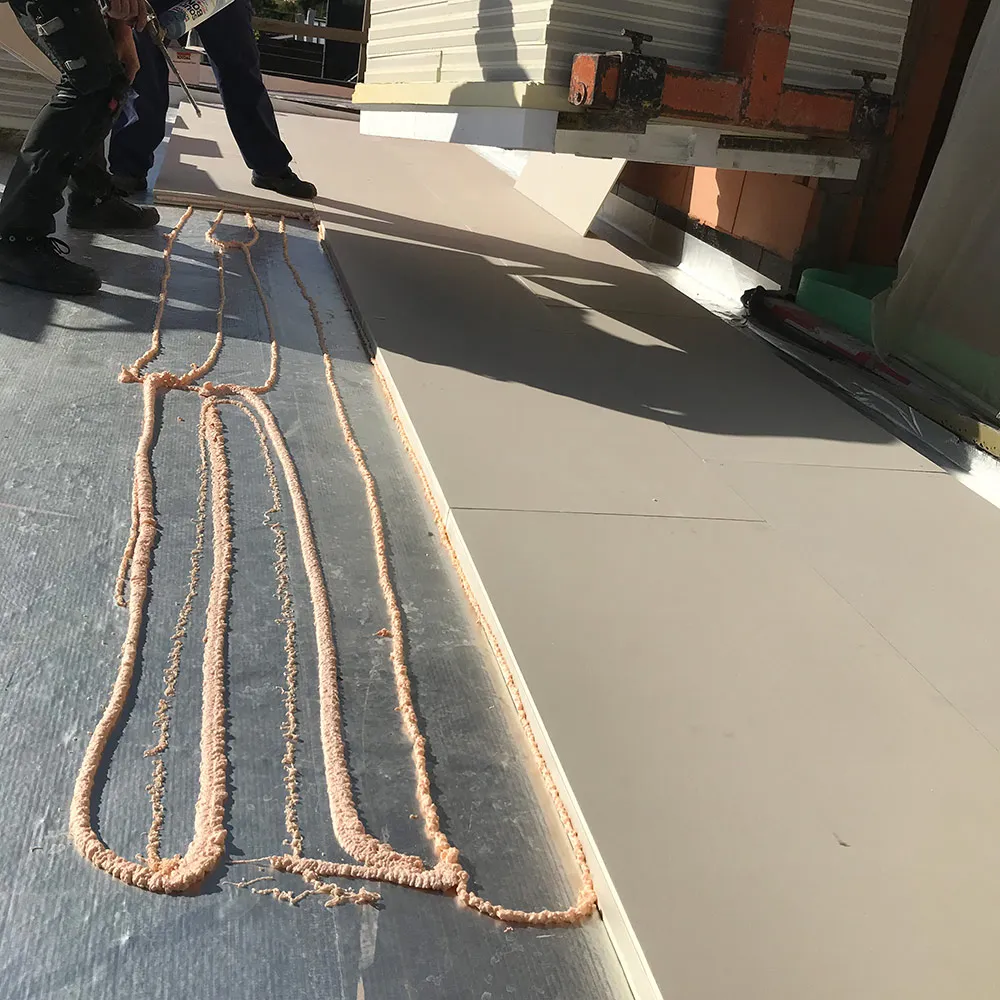
VIPs can only be installed via: - Cold bonding using polyurethane adhesive
- Loose laying under ballast
Mechanical fixing (e.g., drilling) is strictly forbidden to preserve vacuum integrity. - Storage and Moisture Protection
- Store panels in a dry, protected environment before installation
- Place a suitable vapour barrier under the insulation
- Seal the insulation layer and raise vapour barriers at edges to prevent moisture penetration
By adhering to these installation practices, Deck-VQ panels deliver maximum thermal resistance and maintain long-term performance.
FAQs
Vacuum insulation
Can I walk on Deck-VQ® vacuum insulation panels?
Yes, this is possible due to the protection layers in high density PIR and the compressive strength of 150 kPa (CS(10\Y)150). Deck-VQ® is suitable for application in flat roofs and terraces, subject to light foot traffic.

As for every type of insulation, we recommend to limit the foot traffic during installation to a minimum and apply the waterproofing as soon as possible after installation. It is best practice to only install the area you are able to insulate AND waterproof in one day.
Can you drill, nail or saw into a Vacuum Insulation Panel?
No, because these actions will lead to the loss of vacuum in the VIP and reduce the thermal performance by a factor of three*.
Our Deck-VQ® concept offers an optimum protection to prevent most damage on site. (see “What is the difference between Deck-VQ® and a Vacuum Insulation Panel?”).
Our technical services provide guidance and deliver a detailed design for your project.
Do not hesitate to contact us for further information.
*The thermal conductivity of the core material rises to ca. 0,020 W/mK under ambient pressure.
What is a Vacuum Insulation Panel or VIP?
VIP is the abbreviation of Vacuum Insulation Panel. A Vacuum Insulation Panel generally comprises a microporous core material (e.g. based on fumed silica), which is introduced into a high barrier multilayer foil envelope. The envelope is then evacuated and sealed, obtaining a near vacuum inside the envelope.
Because of the microporous core and the absence of air, excellent thermal properties are obtained. For our Vacuum Insulation Panel as such (Core-VQ®) we can declare a lambda value of 0,006 W/mK, which is typically 3-5 better than traditional insulation materials.
Vacuum Insulation Panels have already been used for several decades in high demanding applications, especially when stringent requirements for thermal insulation are set (e.g. refrigerators). As the thermal insulation of buildings has become increasingly important over the last years, Vacuum Insulation Panels have been introduced in buildings to meet the high standards.
Recticel Insulation offers the following products:

What is vacuum insulation and how does it work?
Vacuum insulation panels, or VIPs, are high-performance insulation panels designed to provide a high level of thermal resistance within a relatively small thickness.
Gradient's VIP technology uses a core based on pyrogenic silica enclosed within a gas-tight multilayer film. The panel is then protected within a high-density, pressure-resistant PIR casing in the Deck-VQ® system.
The vacuum and core structure significantly reduce heat transfer through the insulation, allowing very high thermal performance from a relatively thin panel.
Vacuum insulation is particularly useful where there is insufficient space to accommodate the thickness of conventional insulation.